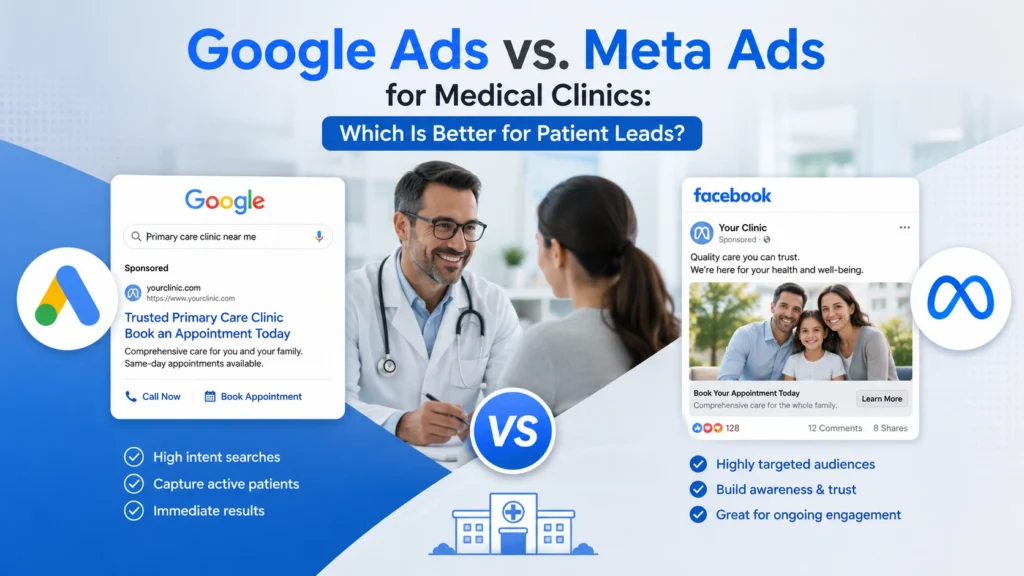
Medical clinics often ask a simple question: should we spend our advertising budget on Google Ads or Meta Ads?
The better question is usually: what role should each channel play in the patient acquisition strategy?
Google Ads and Meta Ads reach people differently. Google can capture demand when someone is actively searching, while Meta platforms can help clinics reach selected audiences while they are browsing social content. The right choice depends on the service, objective, geography, creative assets, and conversion path.
Google Ads: Capture Existing Search Demand
Google Ads is especially useful when people are already searching for a service. A user who types a specific healthcare-related query is demonstrating an active need or interest.
For a medical clinic, this can make search advertising for doctors attractive for services with clear search intent and defined geographic demand.
[ inline image 16:9 — search intent vs. audience discovery comparison ]Meta Ads: Create Awareness and Demand
Meta advertising can serve a different role. Facebook and Instagram allow businesses to present visual content to selected audiences and introduce services to people who may not be searching at that exact moment.
This can be useful for campaigns where education, visual storytelling, offers, new services, or awareness are important parts of the strategy.
Google Ads vs. Meta Ads: A Simple Comparison
Google Ads generally begins with a search: the person is looking for something. Meta Ads generally begins with an audience: the person is browsing and encounters the clinic’s content.
That difference can affect creative, messaging, landing pages, and expectations. Search campaigns often emphasize relevance to the query. Social campaigns often need stronger visual communication and a reason to stop scrolling.
Which Is Better for a Medical Clinic?
There is no universal winner. A clinic with strong existing search demand for a service may benefit from Google Ads first. A clinic launching a new service or trying to build awareness may find Meta Ads valuable.
Some practices can use both: Google Ads to capture active demand and Meta Ads to build awareness, educate audiences, and support campaigns.
[ inline image 16:9 — patient journey: discover → learn → visit → inquire ]
Your Website Is the Common Conversion Layer
Regardless of the ad platform, the website matters. The visitor should land on a page that matches the ad’s message, explains the service clearly, establishes trust, and provides an obvious next step.
This is why advertising performance cannot be separated completely from clinic website development. A strong campaign can bring visitors, but the website has to help those visitors move forward.
Use Different Creative for Each Platform
A search ad is constrained by the search environment and should communicate value quickly. A social ad has more opportunity to use imagery, video, educational content, and storytelling.
Rather than copying the same creative everywhere, clinics should adapt the message to the way people use each platform.
[ inline image 4:3 — clinic social ad creative mockup ]Measure Leads, Not Just Clicks
Both platforms can generate traffic, but the clinic should define what counts as a lead. Phone calls, appointment requests, contact submissions, and other meaningful actions can be tracked where the technical setup allows.
The goal is to understand which campaigns contribute to real business outcomes.
Conclusion
Google Ads and Meta Ads are not necessarily competing channels. They can play different roles in the same healthcare marketing strategy.
For many independent clinics, the strongest approach is to build a conversion-ready website first, then use Google Ads and Meta Ads according to the clinic’s goals, services, audience, and available budget.
Google Ads, Meta Ads, or both?
Pacific Digital provides healthcare-focused digital advertising and website development for independent medical practices in the Inland Empire.
Talk Through Your Options ← All articles Next: What your site needs →