Digital marketing has become one of the most important ways dental practices attract new patients. People often search online when they need a dentist, compare local practices, research specific treatments, and decide which office to contact.
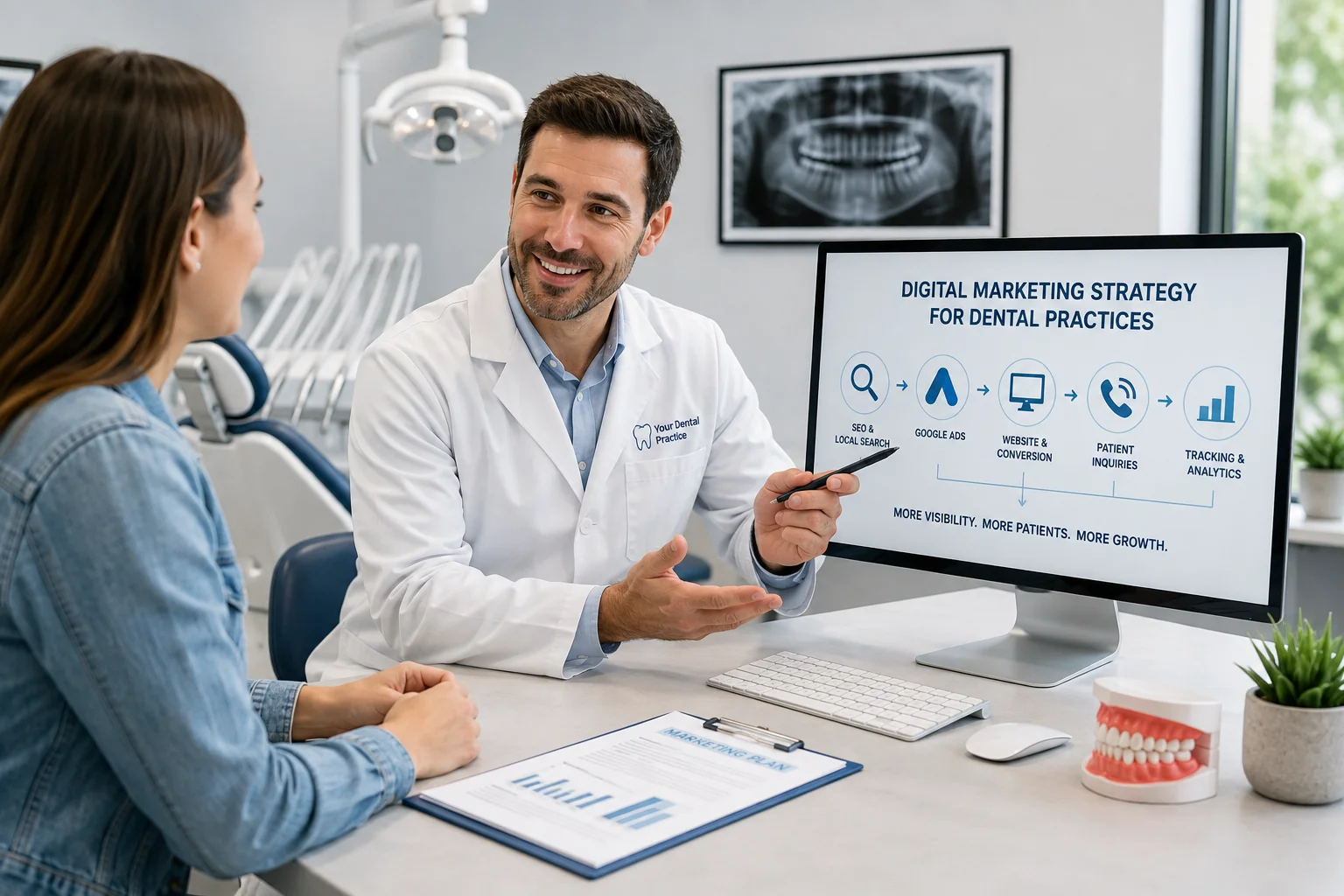
For dental practices, the goal isn’t simply to generate more website traffic. A strong dental digital marketing strategy connects search visibility, advertising, website conversion, local presence, and tracking so more of the right people can find the practice and take the next step.
In this guide, we’ll look at the major digital marketing channels dental practices can use to attract qualified patient inquiries and how those channels work together.
What Does Dental Digital Marketing Include?
Dental digital marketing isn’t a single service. It’s a set of channels that can work together to help a practice get found, earn trust, and turn interest into booked appointments. Depending on the practice, a strategy might include some or all of the following:
- Search engine optimization (SEO)
- Local SEO
- Google Ads
- Dental practice website design
- Conversion optimization
- Online reputation and reviews
- Content marketing
- Conversion tracking and analytics
The most effective mix depends on the practice — its location, services, competition, growth goals, budget, existing website, and current visibility. Not every practice needs every channel, and a good strategy focuses on the ones that will actually move the needle for that specific office.
Why Patients Search Online Before Choosing a Dentist
Most people don’t choose a dentist at random. When they need care — or are considering a treatment — they usually research online first. A typical path might look like this:
- Search for a dentist nearby
- Search for a specific treatment
- Compare several practices
- Look at practice websites
- Read reviews
- Check location, hours, and services
- Call or request an appointment
A practice can lose potential patients at any of these steps — if it’s hard to find in search, hard to trust once someone lands on the site, or hard to contact. Dental digital marketing is really about removing that friction at each stage so more of the right people take the next step.
Dental SEO Helps Practices Get Found Organically
Search engine optimization helps a practice appear in Google’s organic results and map listings when people look for dental care. For most offices, that means focusing on local visibility. Practical dental SEO work usually includes:
- Google Business Profile optimization
- Local search visibility
- Service and treatment pages
- Location relevance
- A clear website structure
- Technical SEO (speed, mobile, crawlability)
- Internal linking
- Helpful content that matches search intent
SEO is generally a long-term channel — it builds momentum over months rather than days, and it can’t guarantee a specific ranking position or timeline. What it can do is steadily lower the cost of acquiring patients over time. For a closer look at how this works, our dental SEO services cover on-page, local, and technical SEO in more detail.
Google Ads Can Reach Patients Ready to Search
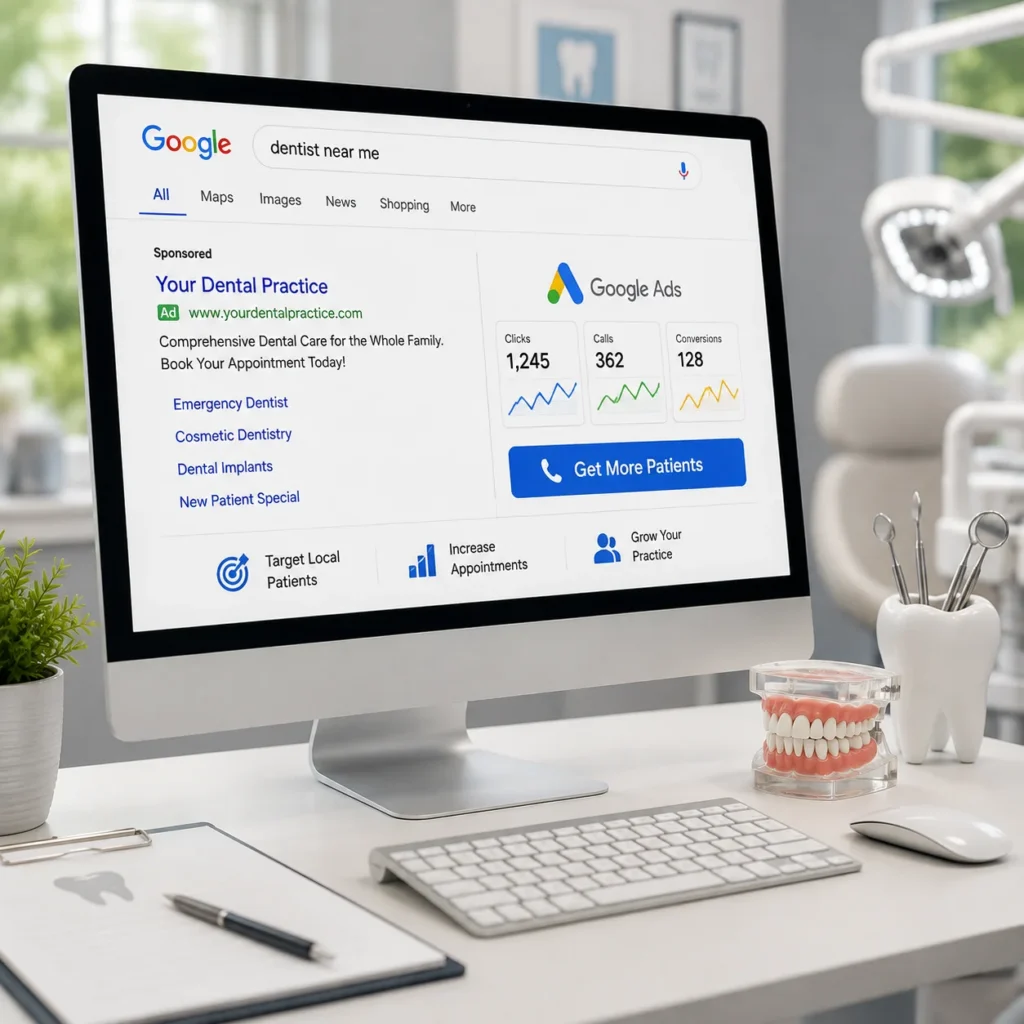
Where SEO builds visibility over time, paid search can put a practice in front of people who are searching right now. With Google Ads for dentists, campaigns can target specific services and a defined geographic area, with direct control over budget and messaging.
Campaigns often focus on searches such as dentist, emergency dentist, dental implants, cosmetic dentistry, Invisalign, and teeth whitening — but the right keywords should always reflect the services a practice actually offers and wants to grow. Sending that traffic to a relevant landing page, and tracking calls and appointment requests, is what turns clicks into inquiries.
Results depend on competition, services, location, budget, landing pages, and tracking, so it’s best to treat early campaigns as a starting point to optimize rather than a fixed formula.
Your Dental Website Turns Marketing Traffic Into Opportunities
SEO and advertising can bring people to a website, but the site has to do the rest of the work. A strong dental practice website makes it obvious what the practice offers and easy to take the next step. That usually means:
- Clearly presented services
- Strong, visible calls to action
- A mobile-friendly experience
- Click-to-call on phones
- Simple appointment requests
- Trust elements like credentials and real photos
- Easy navigation
- Fast loading
- Relevant landing pages
- Conversion tracking
Traffic alone isn’t the goal. The website’s real job is to turn interest into calls and appointment requests. Thoughtful dental website design and development treats the site as part of the patient-acquisition strategy, not a separate project.
Local Search and Reviews Matter for Dental Practices
Because dentistry is local, a practice’s visibility in local search and its reputation carry real weight. A complete Google Business Profile, accurate and consistent business information, genuine patient reviews, and pages that reflect the practice’s services and location all reinforce one another. Visibility helps people find the practice; reputation helps them choose it. We’ll go deeper on this in a future article focused specifically on dental SEO.
Track Calls, Appointment Requests, and Real Leads
One of the biggest gaps in dental marketing is not knowing what happens after someone clicks an ad or lands on the website. Without tracking, it’s difficult to tell which channels actually produce patients. A practical setup measures:
- Phone calls
- Appointment requests
- Contact form submissions
- Landing-page conversions
- Campaign and source information
- Website engagement
This is the difference between traffic metrics and business outcomes. A campaign that earns a lot of clicks isn’t necessarily successful if those clicks don’t lead to meaningful inquiries. Tracking real actions is what lets a practice invest with confidence and shift budget toward what works.
How the Channels Work Together
None of these channels performs at its best in isolation. They work as a connected system, where each step supports the next:
Helps people discover the practice through organic search.
Builds trust and makes it easy to take action.
Provides paid visibility for relevant searches.
A call or appointment request becomes the measurable conversion.
Shows which channels and campaigns generate inquiries.
Uses the data to improve the strategy over time.
When these pieces connect, each one makes the others more effective — search and ads feed a website built to convert, and tracking shows where to invest next.
When Should a Dental Practice Invest in a Digital Marketing Strategy?
There’s no single right time for every practice, but a coordinated strategy often makes sense when a practice:
- Wants to increase new-patient inquiries
- Is opening a new location
- Is introducing new services
- Has strong clinical services but weak online visibility
- Is advertising without reliable conversion tracking
- Has an outdated website
- Wants to compete more effectively in local search
- Wants marketing channels it can actually measure
The right combination depends on the practice’s market, goals, services, competition, website, and budget — which is why a strategy should be built around the specific office rather than a generic package.
A Better Approach to Dental Digital Marketing
A dental practice doesn’t necessarily need more marketing channels. It needs the right channels working together. Many practices benefit from combining SEO for long-term visibility, Google Ads for immediate search demand, a conversion-focused website, local search optimization, and reliable tracking — but the real advantage comes from connecting those pieces instead of treating each one as a separate activity.
Pacific Digital helps dental practices throughout Southern California and the Inland Empire connect these channels into a coordinated patient-acquisition strategy. If you’d like to see how it fits together, our dental marketing services page walks through the approach.
Frequently Asked Questions
Dental digital marketing is the use of online channels — such as SEO, local search, Google Ads, a practice website, content, online reputation, and conversion tracking — to help a dental practice attract and convert prospective patients. It’s less about any single tactic and more about how those channels work together to produce measurable patient inquiries.
It can improve a practice’s visibility in search, attract more relevant traffic from people looking for dental care, make it easier for prospective patients to get in touch, and provide measurable data on what’s actually working. The goal is more qualified inquiries — not simply more website visits.
They serve different purposes. SEO is generally a long-term strategy that builds organic visibility over time, while Google Ads can generate visibility for relevant searches more quickly. Many practices use both — ads for immediate demand and SEO for durable, lower-cost visibility — rather than choosing one over the other.
Very. The website is usually where traffic from search and advertising lands, so it needs to clearly communicate services, establish trust, and make calling or requesting an appointment easy. Even strong SEO and ad campaigns underperform if the site doesn’t help visitors take the next step.
Look beyond traffic. The most useful metrics are real actions: phone calls, appointment requests, form submissions, and which campaigns or sources produced them. Tracking these outcomes shows whether marketing is generating patient opportunities, not just clicks.
Ready to Build a Stronger Dental Marketing Strategy?
If your dental practice is ready to improve its online visibility, attract more qualified inquiries, and connect SEO, advertising, and website conversion into one strategy, Pacific Digital can help. We work with businesses throughout Southern California and the Inland Empire and can evaluate your current website, SEO, advertising, and patient-acquisition opportunities.